
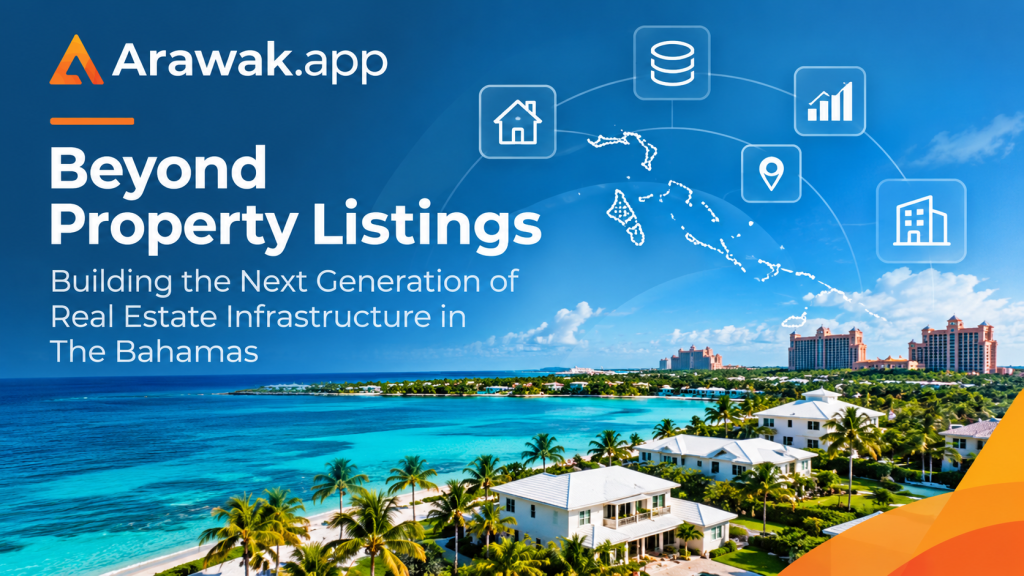
The real estate industry in The Bahamas has undergone a significant digital transformation. Property discovery increasingly happens online, agents rely on digital marketing to reach prospective buyers, and brokerages use a growing collection of tools to manage their businesses.
Yet digitizing property listings is not the same as digitizing the real estate industry.
Behind every property listing is a network of information, professional relationships, business processes, and institutional requirements. How effectively these elements connect has important implications for the efficiency, transparency, and long-term development of the Bahamian property market.
As the industry evolves, the next opportunity may lie beyond creating more places to advertise properties. It may lie in strengthening the digital infrastructure that supports the market itself.
The Evolution of Property Discovery
For buyers and investors, the most visible aspect of real estate technology is the property search experience.
Online portals, brokerage websites, digital photography, virtual tours, and social media have made it easier to discover properties without first visiting a real estate office.
For professionals, these tools have expanded marketing reach and introduced new ways to engage prospective clients, including international buyers interested in Bahamian real estate.
This evolution is important, particularly in a market where international investment, second-home ownership, and tourism-related development contribute to property demand.
However, the ability to discover a property online represents only one part of a much larger process.
A buyer may find a listing through one platform, contact an agent through another, exchange documents by email, and coordinate with financial institutions and legal professionals through separate systems.
Each participant may maintain their own version of the relevant information.
The result is a digital experience that can appear connected from the outside while remaining fragmented behind the scenes.
Why Property Data Matters as Much as Property Listings
A property listing is ultimately a presentation of information.
It may contain an asking price, location, photographs, property characteristics, availability, and contact details. But the usefulness of that information depends on its accuracy, consistency, and ability to remain current.
Consider a property marketed through several channels.
If its price changes, its availability changes, or its description is updated, those changes may need to be reflected across multiple websites and internal systems.
Without reliable synchronization, discrepancies can emerge.
For an individual brokerage, this creates additional administrative work. For consumers, it can create confusion. For institutions seeking to understand market activity, inconsistent records can complicate analysis.
This illustrates an important distinction:
A listing platform helps people find properties. A property data infrastructure helps the wider industry manage, exchange, and use property information.
The two are closely related, but they solve different problems.
A mature digital property ecosystem benefits from both.
Moving from Isolated Systems to Connected Infrastructure
Real estate businesses have different operational requirements.
A small brokerage may prioritize listing management, lead generation, and client communications. A larger organization may need agent management, internal reporting, transaction workflows, and integrations with external services.
Developers may require inventory management across multiple projects. Property managers need tools for leases, maintenance, occupancy, and financial reporting.
Banks, valuation professionals, and other institutions have different requirements again.
It would be unrealistic to expect every participant to operate through one application.
A more useful long-term objective is to make it easier for specialized systems to exchange appropriate information through clearly defined standards and interfaces.
This is where concepts such as structured property records, application programming interfaces (APIs), data governance, and interoperability become important.
For example, a brokerage should ideally be able to maintain authoritative property information within its operational workflow and distribute approved information to multiple channels without repeatedly entering the same data.
Similarly, an institution evaluating a market should be able to work with consistent, appropriately sourced information rather than relying entirely on manually assembled datasets.
Achieving this requires more than software development. It requires agreements about data ownership, permissions, quality, access, and responsibility.
Technology can facilitate cooperation, but it cannot replace the professional and institutional frameworks that make cooperation possible.
The Importance of Local Market Realities
The Bahamas is not simply a smaller version of a North American property market.
Its geography, professional environment, international buyer activity, and mix of residential, commercial, resort, and development properties create distinct requirements.
Properties are distributed across multiple islands, and the information relevant to a transaction may vary considerably depending on the location and property type.
International buyers may also need to navigate unfamiliar professional processes and regulatory requirements.
These characteristics make local market knowledge essential.
Technology designed for the Bahamian market should account for the way local professionals actually operate, rather than assuming that workflows developed elsewhere can be adopted without modification.
At the same time, international real estate technology offers useful lessons.
Common data standards, integrations between brokerage systems, and more sophisticated property analytics demonstrate what becomes possible when information is structured and managed consistently.
The opportunity is to adapt relevant approaches to local requirements, not simply replicate foreign platforms.
What Better Infrastructure Could Mean for the Industry
The benefits of a more connected property information environment extend beyond the technology providers building it.
For brokerages and agents, better infrastructure could reduce duplicate administrative work, simplify property distribution, improve internal coordination, and make it easier to maintain consistent information across marketing channels.
For developers, structured inventory and distribution tools could improve how projects are presented, updated, and managed across different sales relationships.
For banks and financial institutions, more reliable market information could support research, valuation workflows, and risk analysis, provided the underlying data is sufficiently complete, representative, and verified.
For buyers and investors, more consistent information could improve property discovery and support more informed conversations with qualified professionals.
These are potential benefits rather than automatic outcomes.
The quality of the underlying data, participation by industry stakeholders, and appropriate governance arrangements ultimately determine whether technology delivers meaningful improvements.
Infrastructure Requires Trust
One of the most important challenges in building shared industry technology is establishing trust.
Property information can have significant commercial value. Brokerages invest resources in developing listings, maintaining client relationships, and managing proprietary business information.
Any infrastructure intended to serve multiple participants must respect these interests.
That means being clear about who owns information, who may access it, how it can be distributed, and what happens when a participant changes systems or commercial relationships.
It also means distinguishing between information intended for public marketing and information that should remain private, restricted, or available only to authorized professionals.
Strong infrastructure should enable collaboration without requiring businesses to surrender control over their operations or sensitive data.
In this sense, governance is not a secondary technical consideration. It is a foundational requirement.
Building Toward a More Connected Bahamian Property Market
The future of real estate technology in The Bahamas is unlikely to be defined by a single website or application.
It will be shaped by how effectively property professionals, technology providers, institutions, and other stakeholders develop systems that work together.
Listing portals will continue to play an important role in property discovery. Brokerage management systems will remain essential to daily operations. Specialized tools will continue to emerge for transactions, analytics, property management, and other industry needs.
The larger opportunity is to connect these capabilities through better information management and thoughtful technology infrastructure.
At Arawak, we believe this is a conversation worth advancing.
Our interest extends beyond how properties are presented online to how property information can be organized, distributed, and used more effectively across the market.
Through this publication, we will explore the technologies, market developments, operational challenges, and emerging opportunities shaping real estate in The Bahamas and the wider Caribbean.
Because the next stage of digital transformation is not simply about making more property information available.
It is about making that information more useful, reliable, and connected.